Sourced from Bradford Farm
Pepper - Jimmy Nardello 9lb
Pepper - Jimmy Nardello 9lb
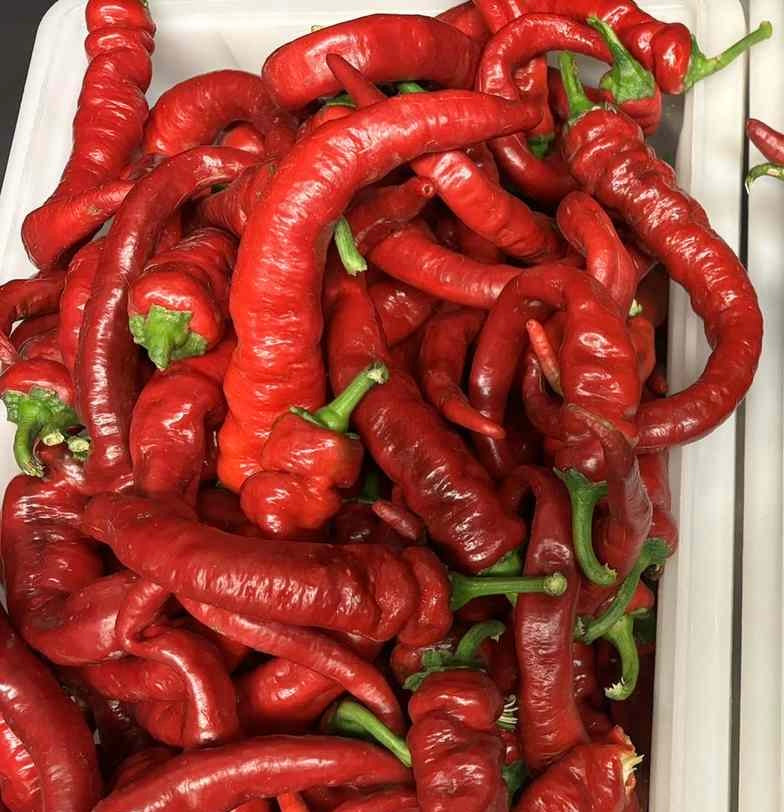
One of the chefs’ favorites and pretty hard to come by! This long, thin, brilliant-red Italian frying pepper traces back to the small mountain village of Ruoti in Basilicata, southern Italy. In 1887, Giuseppe and Angella Nardiello left Italy for the United States, carrying seeds from the sweet frying pepper they had grown in their family garden. They settled in Naugatuck, Connecticut, where they planted those seeds again and raised eleven children.
Their fourth child, Jimmy, inherited his mother’s love of the garden. He continued growing the family pepper throughout his life, cultivating it in terraced gardens and preserving the harvest by stringing the peppers to dry for winter. The family variety eventually became known as Jimmy Nardello’s pepper.
There was a very real possibility that the pepper would have remained just that—a family vegetable, eventually disappearing as Jimmy’s generation passed.
However, before Jimmy died in 1983, he gave seeds of the family pepper to Seed Savers Exchange. That simple act put the variety into seed preservation and allowed it to move beyond the Nardello family garden and into the hands of growers across America. Today, Jimmy Nardello is considered one of the great American heirloom peppers. It has even been recognized by Slow Food as an important heritage variety.
That’s just the story… a good story gets the foot in the door but it doesn’t matter if it lacks flavor. Because then it would have no longevity or real place in the kitchen nor American gardens. And then you cook one.
The peppers are long, thin-skinned, and remarkably sweet, with a flavor that becomes almost fruity as they ripen fully to red. Seed Savers Exchange describes them as having a delicious roasted-apple character, and that description is remarkably accurate. There is none of the heavy vegetal character of a bell pepper and very little bitterness. The flesh is delicate and tender, with a concentrated sweetness that intensifies dramatically when exposed to high heat.
This is a pepper made for a hot pan.
In the Kitchen
The traditional preparation is also probably the best one: fry them hard in olive oil until blistered and collapsing, then finish with good salt.
But they have considerably more range:
- Blister whole and serve alongside grilled fish, pork, or chicken
- Fry slowly in olive oil until sweet and almost jammy
- Roast and fold into sauces, relishes, or vinaigrettes
- Serve raw in thin slices when fully ripe
- Preserve in olive oil
- Pickle while still green
- Dry ripe peppers for use through the winter
- Fold into eggs, pasta, beans, or risotto
- Pair with anchovy, garlic, tomato, fresh cheeses, or cured meats
- Pepper jelly (“Jimmy Nardelly” as my friend chef Joseph Harrison says)
The ripe red peppers are especially beautiful when cooked slowly. Their thin walls collapse quickly, concentrating the sugars and creating something almost halfway between a roasted pepper and a fruit preserve.
Wild Hope Farm is growing these because they deserve to be eaten at their best—not because they’re fashionable, but because they’re one of those old varieties where the story and the eating quality happen to be equally good.
A handful of seeds crossed the Atlantic in 1887.
A boy named Jimmy kept planting them.
And more than a century later, we’re still eating what his mother carried with her from Italy.