Sourced from Bradford Farm
*Tomato - Plate de Haiti (Heirloom - Paste/Sauce/Fresh) 20lb
*Tomato - Plate de Haiti (Heirloom - Paste/Sauce/Fresh) 20lb
The Plate de Haiti is one of the oldest documented tomatoes still in cultivation today. Long before tomatoes became the backbone of Italian cooking or found their way into every Southern garden, this remarkable variety had already been illustrated in European botanical works. It appears in Conrad Gessner’s Historia Plantarum in 1561, making it one of the earliest documented cultivated tomatoes known to history.
At the time, the tomato was still an exotic curiosity from the New World. Its American story begins more than two centuries later.
In 1793, as the Haitian Revolution reshaped the Atlantic world, thousands of Creole refugees fled the island of Saint-Domingue, carrying with them little more than what could fit aboard a ship. Among the belongings that survived the journey were seeds—small pieces of home that represented hope as much as food—and the Plate de Haiti tomato was one of them.
Those refugees brought the tomato into American port cities, particularly Charleston, Savannah, New Orleans, Philadelphia, and other coastal communities where French and Creole influence would forever shape American cuisine. Food historian William Woys Weaver later identified the Plate de Haiti in paintings by the Peale family of Philadelphia from that period, confirming that this tomato was already growing in America decades before tomatoes became widely accepted as food.
I would encourage you to think about that for a moment.
This was before pizza… before tomato sauce became synonymous with Italy… and before the tomato had earned the trust of American gardeners.
This little tomato was already here. It survived revolutions, made it across oceans, and survived centuries because generation after generation believed it was worth saving. That alone would make it remarkable. Fortunately, it also happens to be an extraordinary tomato.
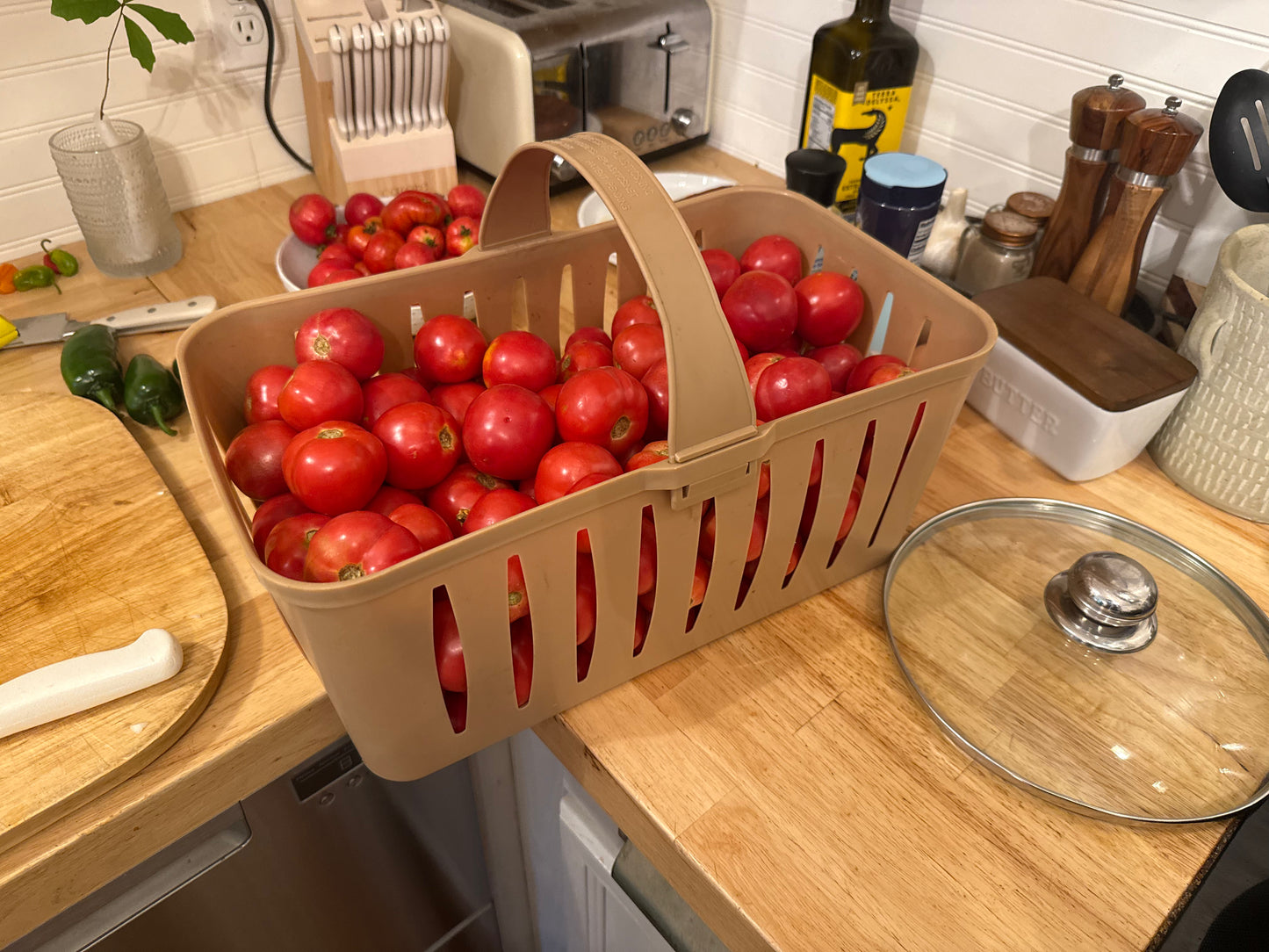
Known historically as “Manzana de Hispaniola”—“The Apple of Hispaniola”—the fruits are striking. Slightly flattened and almost apple-shaped, they ripen to an intense vermilion red that seems to glow in late afternoon light. Plate de Haiti literally translates to “Flat of Haiti”, which is curious because there were much flatter fruits belonging to Haiti back then.
Inside, they’re remarkably meaty.
The seed cavities are small, the walls thick, making the Plate de Haiti one of those rare tomatoes equally comfortable being eaten fresh or transformed by heat.
Last winter I spent weeks researching this variety, trying to decide whether it deserved space in our fields. The history was compelling, but history alone isn’t enough. A crop has to earn its place at Bradford Farm because we have limited space and we want our time, space and resources to only go into the most prestige crops we can find seeds for. This tomato did, it earned a very small section in a raised bed, trellised garden. I also reached out to Maynard Dorr at Dorr Farms to grow a scaled crop for restaurant sales, which ended up being a great success. Yielding 100+ pounds of the beautiful little fruits per week right off the bat.
The first evening of the harvest, my dad walked inside with a basket full and immediately started cooking a family favorite and one of the oldest Southern combinations there is: okra and tomatoes.
We were super pleased with the result, although he used a higher okra to tomato ratio than usual, the dish retained its complexity and depth of flavor. The tomato really stole the show.
Its texture was almost luxurious. Dense without being heavy. The flesh broke down slowly, creating body rather than simply releasing water. The flavor wasn’t loud or aggressively acidic like many modern heirlooms. Instead, it was rounded. Fruity. Deeply tomato. Everything felt integrated—sweetness, acidity, umami—none competing for attention, it was simply complete. That’s become the defining characteristic of the Plate de Haiti for us.
Not intensity, but balance.
The first chef we offered them to was Linton Hopkins, who immediately purchased one hundred pounds to slowly confit in some high falutin’ luxurious olive oil—a preparation that makes perfect sense once you’ve tasted them. Their dense flesh concentrates beautifully while preserving their shape, allowing the tomato to become richer without losing itself.
Flavor & Texture
- Dense, exceptionally meaty flesh
- Small seed cavities
- Balanced acidity with natural sweetness
- Round, fruit-forward tomato flavor
- Silky texture when cooked
- Outstanding concentration without becoming pasty
For the Kitchen
The Plate de Haiti rewards restraint.
- Slow confit in olive oil
- Long-simmered sauces, where body develops naturally without excessive reduction
- Roasting, allowing the sugars to concentrate while the fruit holds together
- Okra and tomatoes, one of the oldest and finest Southern pairings
- Tomato preserves and jam
- Fresh slicing, when fully ripe and still warm from the field
- Light braises with seafood or shellfish, where its softer acidity complements rather than overwhelms
Unlike many modern sauce tomatoes bred simply for solids, Plate de Haiti offers complexity. It has enough flesh for cooking, enough juice for freshness, and enough balance to excel at both.
Some heirlooms survive because they’re beautiful.
Others because they’re productive.
The Plate de Haiti survived because people carried it through one of history’s greatest upheavals, planted it in unfamiliar soil, and believed it deserved a future.
Today, more than four centuries after it was first documented and over two hundred years after it crossed the Caribbean with families seeking a new beginning, it finds its way into our fields—and, for the first time, into the kitchens of the chefs we serve.
For us, it isn’t just another heirloom tomato, more rather a story you can taste.