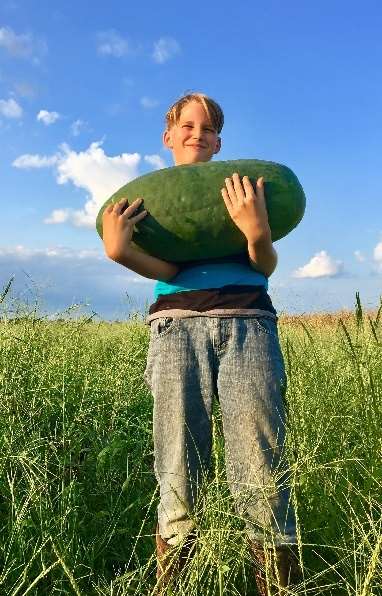
Sourced from Bradford Farm
Bradford Watermelon
Bradford Watermelon
My Great-great-great grandfather bred this watermelon over 180 years ago. It has a delicate and succulent deep pink flesh that is sweet and refreshing. The aroma once cut fills the room and is intoxicating. The rind is thick, but so tender that it is eaten raw like crisp cucumbers. It was bred to have the perfect rind for pickling. It has been recorded in numerous publications and hailed by chefs and the public as quite possibly the best watermelon in existence. We grow them in limited quantity and is one of the few crops available to the public by preorder only. However, for chefs we have them available through our normal weekly deliveries when in season.
Before the Civil War, if you asked someone what the finest watermelon in America was, there is a good chance they would have answered simply: the Bradford.
Developed in South Carolina during the 1840s by Nathaniel Napoleon Bradford in Sumter County, the Bradford Watermelon quickly became one of the country’s most celebrated fruits. Newspapers praised its extraordinary sweetness. Seed catalogs called it the finest flavored watermelon in cultivation. It became the watermelon shipped to northern markets by rail and steamboat, commanding premium prices because nothing else tasted quite like it.
Then it disappeared.
Not because people stopped loving it—but because commerce changed.
The Bradford has an exceptionally thin rind. That delicate skin protects fruit of incredible eating quality, but it doesn’t tolerate rough handling. As railroads expanded and watermelon production shifted toward varieties that could survive being stacked, shipped, and handled by the ton, the Bradford simply couldn’t compete. Flavor lost to freight.
By the early 1900s, it had virtually vanished from American agriculture.
Fortunately, it never vanished from our family.
For more than 175 years, the Bradford Watermelon has remained in our family’s fields, passed from one generation to the next. Every season, seed is saved only from the finest fruit, continuing the same quiet process of selection that began in the nineteenth century.
Today, Bradford Farm is one of the only places in the world growing the original family strain.
What Makes It Different?
The first thing you’ll notice isn’t sweetness.
It’s aroma.
A ripe Bradford perfumes the room before it’s even cut. The fragrance is unmistakably watermelon, but deeper—almost floral, with notes of ripe melon, wildflowers, and fresh summer fields.
Then comes the texture.
The flesh is incredibly fine-grained, almost melting rather than crunching. It carries an unusually high juice content without becoming watery, coating the palate instead of simply disappearing.
And then the flavor arrives.
Not one-dimensional sugar, but layers.
Bright watermelon upfront, followed by floral notes, honeyed sweetness, gentle minerality, and a finish that seems to linger long after the bite is gone. The sugars are balanced by natural acidity, creating intensity without becoming cloying.
It’s difficult to describe because modern watermelons simply don’t taste like this.
A Watermelon Built for Chefs
The Bradford has long been appreciated for more than fresh eating.
Historically, Southern cooks wasted nothing.
The rind was transformed into one of the South’s great preserves—Bradford Watermelon Rind Preserves—a recipe that has become almost as famous as the melon itself. The white rind develops an almost translucent quality, carrying warm spices and citrus while maintaining remarkable texture.
The flesh lends itself equally well to refined cooking.
Kitchen Applications
- Serve simply, lightly chilled, allowing the fruit to speak for itself.
- Pair with country ham, prosciutto, or cured fish.
- Grill briefly over hardwood to deepen its natural sugars.
- Build cold soups and gazpachos.
- Compress with herbs or citrus.
- Produce intensely flavored granitas and sorbets.
- Juice for cocktails, shrubs, and reductions.
- Preserve the rind for relishes, pickles, or the traditional Bradford rind preserves.
Every part of the fruit has value.
The Bradford said to be remarkable because it’s rare. It’s rare because people stopped growing fruit for flavor.
This watermelon represents a different philosophy—one where eating quality mattered more than shelf life, where families selected seed because a melon made people stop talking around the table, and where agriculture was measured by taste rather than shipping efficiency.
Every Bradford Watermelon we harvest carries nearly two centuries of continuous stewardship by our family.
It is the same watermelon that once built South Carolina’s reputation as one of America’s great melon-growing regions. The same watermelon that nearly disappeared and the same one that continues to remind us that the best varieties aren’t always the ones that survive industrial agriculture. They’re often the ones that small groups of folks, who care a whole awful lot, refuse to let disappear.
The Bradford Watermelon is our family’s story, written in seed.